A pressing comb is a deceptively simple tool: a metal comb that is heated and drawn through the hair to straighten it. But for a manufacturer or a distributor sourcing Pressing Comb Brass, the simplicity is misleading. The brass body must heat evenly, hold its temperature, resist corrosion from hair products and moisture, and protect the user from burns. A comb that heats unevenly will create hot spots that damage hair. A comb with sharp edges will scratch the scalp. A comb made from the wrong alloy will corrode, discolor, and shed metal particles. These are not minor defects. They are safety issues that affect the product's liability and the brand's reputation. For buyers, understanding the features of Pressing Comb Brass that ensure safe daily household use is essential for making a sound procurement decision.
This guide is written for buyers who need to source Pressing Comb Brass that meets the safety and performance expectations of the household market. We will examine the alloy composition, the heat transfer characteristics, the edge and tooth geometry, the surface finish, and the handle design that together determine whether the comb is safe for daily use. We will also provide a specification checklist, supplier evaluation criteria, and detailed product parameters from our factory at Ningbo Ruishi Technology Co., Ltd. Whether you are sourcing combs for retail, private label, or salon supply, this guide will help you select a product that protects the user and satisfies the market.
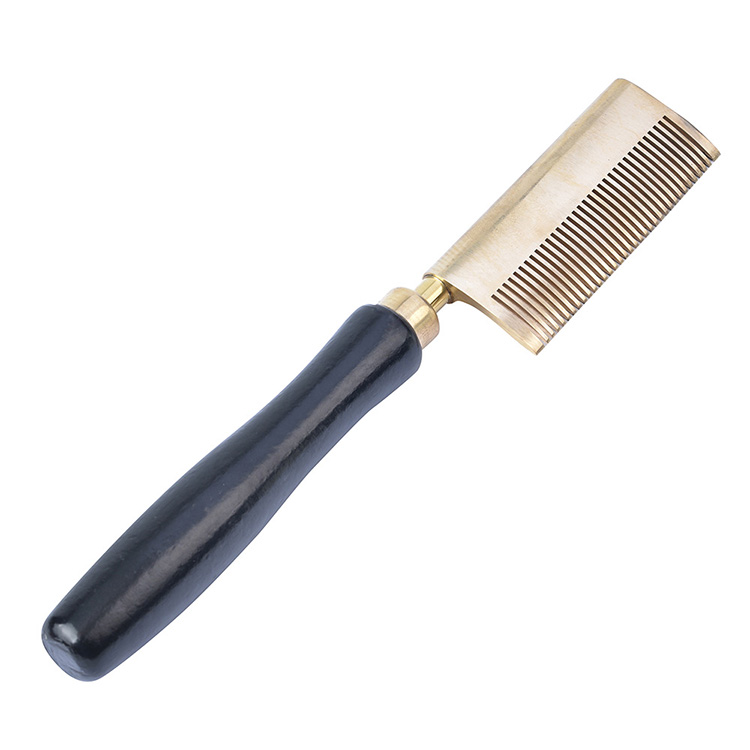
Table of Contents
1. What Is Pressing Comb Brass and Why Does Alloy Selection Matter?
Pressing Comb Brass is not a single material. It is a family of copper-zinc alloys that can be formulated to achieve different combinations of hardness, thermal conductivity, corrosion resistance, and formability. The alloy choice determines how the comb behaves when heated, how long it holds its temperature, how it resists discoloration, and how safely it can be used against the scalp. For household use, the alloy must be free from lead and other harmful elements, because the comb is in direct contact with the skin and hair. The table below compares the common brass alloys used for pressing combs.
|
Alloy
|
Copper Content
|
Thermal Conductivity
|
Corrosion Resistance
|
Suitability for Household Use
|
|
C26000 (Cartridge Brass)
|
70%
|
High
|
Good
|
Excellent (lead-free)
|
|
C27000 (Yellow Brass)
|
65%
|
High
|
Good
|
Good
|
|
C36000 (Free-Cutting Brass)
|
61%
|
Moderate
|
Moderate
|
Not recommended (contains lead)
|
|
C22000 (Commercial Bronze)
|
90%
|
Very high
|
Excellent
|
Excellent (lead-free)
|
At Ningbo Ruishi Technology Co., Ltd., our factory specifies lead-free brass alloys for all of our Pressing Comb Brass products. We verify the alloy composition with a spectrometer before the material enters production. We also require mill test certificates from our suppliers to ensure traceability. For household products, this attention to alloy selection is not optional. It is the foundation of product safety.
2. How Does Heat Transfer Affect Safety and Hair Health?
The heat transfer characteristics of Pressing Comb Brass determine how evenly the comb heats, how quickly it reaches the working temperature, and how it behaves when it contacts the hair. A brass with high thermal conductivity heats evenly across the teeth, which prevents hot spots that can scorch the hair. It also cools more evenly after use, reducing the risk of accidental burns during handling. The thermal mass of the comb—determined by its size and thickness—determines how long it holds its temperature. A comb with too little thermal mass will cool rapidly and require frequent reheating, which increases the risk of overheating. A comb with excessive thermal mass will take too long to heat and may be uncomfortable to handle. The table below shows the heat transfer properties of the alloys used in our Pressing Comb Brass products.
|
Property
|
C26000 Brass
|
C22000 Bronze
|
|
Thermal Conductivity (W/m·K)
|
120
|
190
|
|
Specific Heat (J/kg·K)
|
380
|
380
|
|
Typical Working Temperature
|
150°C - 180°C
|
150°C - 180°C
|
|
Heat-Up Time (typical)
|
3-5 minutes
|
2-4 minutes
|
|
Temperature Uniformity
|
Good
|
Excellent
|
At our factory, we test the heat distribution of each Pressing Comb Brass design using a thermal imaging camera. We verify that the temperature variation across the teeth is within 5°C of the set point. This testing ensures that the comb heats evenly and does not create hot spots that could damage hair or scalp. Our engineering team can work with you to select the alloy and dimensions that provide the optimal thermal performance for your target market.
3. What Edge and Tooth Geometry Prevents Scalp Injury?
The edge and tooth geometry of a Pressing Comb Brass is a critical safety feature that is often overlooked in procurement. The teeth must be smooth and rounded to glide through the hair without scratching the scalp. Sharp edges or burrs can cause micro-abrasions that are painful and can lead to infection. The spacing of the teeth must be appropriate for the hair type; too narrow, and the comb will pull and break the hair; too wide, and it will not straighten effectively. The spine of the comb must be smooth and free of sharp edges, because it is often used to press the hair and comes into direct contact with the scalp. The table below summarizes the geometry specifications that we use in our Pressing Comb Brass products.
|
Feature
|
Specification
|
Safety Rationale
|
|
Tooth Tip Radius
|
≥ 0.5 mm
|
Prevents scratching of the scalp
|
|
Tooth Spacing
|
1.5 - 3.0 mm
|
Matches hair type, reduces pulling
|
|
Spine Edge Radius
|
≥ 1.0 mm
|
Prevents injury during pressing
|
|
Surface Roughness (Ra)
|
≤ 0.8 µm
|
Smooth glide, reduces friction
|
|
Burr Free
|
100% inspection
|
Prevents cuts and abrasions
|
At Rayvex, our factory uses precision machining and polishing to achieve these geometry specifications. We inspect every comb for burrs and sharp edges before packaging. Our quality control team uses a profilometer to verify the surface roughness and a visual inspection under magnification to verify the tooth tip radius. This attention to detail is what makes our Pressing Comb Brass safe for daily household use.
4. Why Does Surface Finish Determine Corrosion Resistance?
Brass is naturally resistant to corrosion, but the surface finish of the comb determines how well it resists the combined effects of moisture, hair products, and heat. A polished surface is easier to clean and less likely to harbor bacteria. A rough surface can trap product residue and moisture, leading to tarnish and, in severe cases, corrosion. The surface finish also affects the comb's appearance and tactile feel. A high-polish finish looks premium and glides smoothly through the hair. A matte finish may be preferred for a more understated aesthetic, but it must still be smooth enough to prevent abrasion. The table below summarizes the surface finish options for Pressing Comb Brass.
|
Finish Type
|
Surface Roughness (Ra)
|
Corrosion Resistance
|
Typical Application
|
|
High Polish
|
0.2 - 0.4 µm
|
Excellent
|
Premium retail, salon
|
|
Satin Finish
|
0.4 - 0.8 µm
|
Good
|
Standard retail
|
|
Brushed Finish
|
0.8 - 1.2 µm
|
Moderate
|
Economy, promotional
|
|
Protective Coating
|
N/A
|
Excellent
|
High-humidity environments
|
At our factory, we offer high-polish and satin finishes for our Pressing Comb Brass products. We also offer an optional clear lacquer coating for applications where the comb will be exposed to high humidity or frequent cleaning. Our finishing process includes ultrasonic cleaning and drying before packaging to ensure that no residue remains on the surface. This attention to surface quality is what ensures that our combs resist corrosion and maintain their appearance over years of daily use.
5. How Does the Handle Design Contribute to Safe Daily Use?
The handle of a Pressing Comb Brass is the user's primary point of contact, and its design determines how safely the comb can be handled during use. The handle must be long enough to keep the hand away from the heated teeth, and it must be insulated to prevent heat transfer to the hand. It must also provide a secure grip, even when the user's hands are dry or slick with styling products. The most common handle materials are wood, Bakelite, silicone, and heat-resistant plastic. Each material has its own advantages and limitations. The table below compares the handle materials used in Pressing Comb Brass products.
|
Handle Material
|
Heat Insulation
|
Grip
|
Durability
|
Typical Application
|
|
Wood
|
Good
|
Good
|
Moderate
|
Traditional, premium
|
|
Bakelite
|
Excellent
|
Good
|
Excellent
|
Standard retail
|
|
Silicone
|
Excellent
|
Excellent
|
Good
|
Premium, ergonomic
|
|
Heat-Resistant Plastic
|
Good
|
Moderate
|
Good
|
Economy, promotional
|
At Ningbo Ruishi Technology Co., Ltd., our factory offers Pressing Comb Brass products with a range of handle materials to suit different market segments. We can customize the handle length, shape, and material to meet the specific requirements of our customers. Our engineering team can help you select the handle design that provides the best combination of safety, comfort, and cost for your target market.
6. What Specifications Should Buyers Include in a Purchase Order?
When purchasing Pressing Comb Brass, the buyer should include detailed specifications in the purchase order to ensure that the product meets the required safety and performance standards. The key specifications are the alloy composition, the dimensions, the tooth geometry, the surface finish, the handle material, and the packaging. The alloy composition should be specified by alloy grade (e.g., C26000, lead-free). The dimensions should be specified in millimeters. The tooth geometry should be specified by tooth spacing and tip radius. The surface finish should be specified by Ra value. The handle material should be specified by type. The packaging should be specified by the number of combs per carton. The table below summarizes the specifications that should be included in a purchase order.
|
Specification
|
Unit of Measure
|
Example
|
|
Alloy Composition
|
Alloy grade
|
C26000, lead-free
|
|
Overall Length
|
mm
|
220 mm
|
|
Tooth Spacing
|
mm
|
2.0 mm
|
|
Tooth Tip Radius
|
mm
|
≥ 0.5 mm
|
|
Surface Finish
|
Ra (µm)
|
≤ 0.8 µm
|
|
Handle Material
|
Type
|
Bakelite
|
|
Packaging
|
Units per carton
|
100 combs per carton
|
At our factory, we work with our customers to ensure that all specifications are clearly defined and understood before production begins. We provide samples for approval and maintain strict quality control throughout the production process. Our goal is to deliver Pressing Comb Brass that meets or exceeds our customers' safety and performance expectations.
7. How Do You Evaluate a Pressing Comb Brass Supplier?
Evaluating a supplier of Pressing Comb Brass requires a focus on material traceability, manufacturing capability, quality control, and safety compliance. The supplier must be able to provide mill test certificates for the brass alloy and demonstrate that the material is lead-free. They must have the machining and polishing equipment to achieve the required tooth geometry and surface finish. They must have a quality control system that includes burr inspection, surface roughness measurement, and alloy verification. And they must comply with the relevant safety standards for household products in their target markets. The table below summarizes these evaluation criteria.
|
Evaluation Criterion
|
What to Look For
|
Why It Matters
|
|
Material Traceability
|
Mill test certificates, alloy verification
|
Ensures lead-free, safe material
|
|
Manufacturing Capability
|
CNC machining, polishing, assembly equipment
|
Ensures dimensional accuracy and finish
|
|
Quality Control
|
Burr inspection, surface roughness measurement
|
Ensures safe, smooth product
|
|
Safety Compliance
|
Compliance with household product standards
|
Ensures market access
|
|
Technical Support
|
Material selection, design assistance
|
Helps select the right product
|
At Ningbo Ruishi Technology Co., Ltd., our factory has been producing Pressing Comb Brass for over a decade. We maintain mill test certificates for all brass alloys and verify each batch with a spectrometer. We use precision machining and polishing to achieve the required tooth geometry and surface finish. We are ISO 9001 certified, and we comply with the household product safety standards of our target markets. Our technical team is available to assist with material selection and design. We invite you to evaluate us against these criteria and to consider us as your partner for Pressing Comb Brass.
8. What Are the Key Product Parameters from Our Factory?
The following table provides the key product parameters for our Pressing Comb Brass. These combs are designed for daily household use and are available in a range of sizes and handle options. Our factory can also produce custom combs to meet specific requirements.
|
Parameter
|
Specification Range
|
Notes
|
|
Alloy
|
C26000, C22000 (lead-free)
|
Selected for thermal and corrosion properties
|
|
Overall Length
|
180 - 250 mm
|
Custom lengths available
|
|
Tooth Spacing
|
1.5 - 3.0 mm
|
Selected for hair type
|
|
Tooth Tip Radius
|
≥ 0.5 mm
|
Verified by magnification
|
|
Surface Finish
|
Ra ≤ 0.8 µm
|
High polish or satin
|
|
Handle Material
|
Wood, Bakelite, Silicone, Plastic
|
Selected for market segment
|
|
Heat Resistance
|
Up to 200°C
|
For typical pressing temperatures
|
|
Packaging
|
100 - 500 units per carton
|
Custom packaging available
|
|
MOQ
|
500 pieces
|
Negotiable for large orders
|
|
Lead Time
|
3 - 5 weeks
|
Depends on quantity and customization
|
At our factory, we manufacture our Pressing Comb Brass to meet these specifications and more. We can customize the alloy, dimensions, tooth geometry, and handle to suit your specific requirements. Our quality control system includes alloy verification, dimensional inspection, and surface finish measurement before shipment. Our goal is to provide our customers with high-quality Pressing Comb Brass that is safe for daily household use.
9. Frequently Asked Questions (FAQ)
Question 1: What type of brass is safest for a pressing comb used in the home?
Answer: The safest brass for a pressing comb is a lead-free alloy, such as C26000 cartridge brass or C22000 commercial bronze. These alloys offer good thermal conductivity and corrosion resistance without the health risks associated with lead-containing brasses like C36000. At Ningbo Ruishi Technology Co., Ltd., we use only lead-free alloys for our Pressing Comb Brass products and verify each batch with a spectrometer.
Question 2: How can I tell if a pressing comb has sharp edges that could scratch the scalp?
Answer: Inspect the tooth tips and the spine of the comb under good lighting. Run your finger gently along the edges—if you feel any roughness or sharpness, the comb is not properly finished. A safe comb should have rounded tooth tips with a radius of at least 0.5 mm and a smooth spine with a radius of at least 1.0 mm. Our factory inspects every comb for burrs and sharp edges before packaging.
Question 3: Why does my pressing comb discolor after use?
Answer: Discoloration is usually caused by oxidation or the residue of hair products reacting with the brass surface. A high-polish finish with a protective lacquer coating reduces the risk of discoloration. Clean the comb after each use with a soft cloth and mild soap, and dry it thoroughly before storage. If the discoloration persists, the comb may need to be re-polished or replaced. Our Pressing Comb Brass products are available with an optional clear lacquer coating for added protection.
Question 4: What is the ideal tooth spacing for a pressing comb?
Answer: The ideal tooth spacing depends on the hair type. For fine or medium hair, a spacing of 1.5 to 2.0 mm is appropriate. For thick or coarse hair, a spacing of 2.0 to 3.0 mm is better. The goal is to allow the comb to glide through the hair without pulling or breaking it. Our factory can produce combs with different tooth spacings to suit different market segments.
Question 5: How often should a pressing comb be replaced?
Answer: A well-made Pressing Comb Brass can last for years with proper care. However, if the teeth become bent, the surface becomes rough, or the handle becomes loose, the comb should be replaced. Inspect the comb periodically for signs of wear, and replace it if any safety feature is compromised. Our factory offers a range of replacement combs and handles for customers who need to maintain their inventory.
10. Conclusion
The safety of a Pressing Comb Brass for daily household use is determined by a combination of features: the alloy composition, the heat transfer characteristics, the edge and tooth geometry, the surface finish, and the handle design. Each feature must be specified and verified to ensure that the comb heats evenly, glides smoothly, resists corrosion, and protects the user from injury. At Ningbo Ruishi Technology Co., Ltd., our factory has the expertise and the equipment to manufacture Pressing Comb Brass that meets these requirements. We use lead-free alloys, precision machining, and rigorous quality control to ensure that every comb we produce is safe and reliable.
Whether you are sourcing combs for retail, private label, or salon supply, we invite you to contact us to discuss your requirements. We can provide samples, technical data, and customized solutions. Our commitment to quality and customer safety has made us a trusted partner for businesses around the world.
Contact Ningbo Ruishi Technology Co., Ltd. today to discuss your Pressing Comb Brass requirements and discover how our products can meet your safety and performance standards.